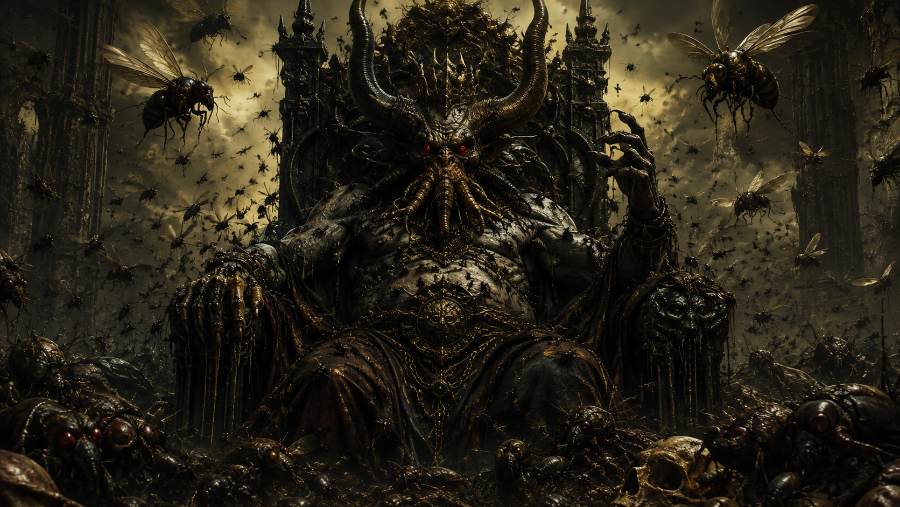
Among the many names found within the history of demonology, few possess a reputation as sinister as Beelzebub. Known widely as the “Lord of the Flies,” this mysterious figure has been described as a pagan deity, a prince of demons and, in later traditions, one of the most powerful inhabitants of Hell.
The story, however, is far more complicated than the familiar image of a monstrous demon surrounded by swarms of flies. Its origins stretch back to the ancient Near East, while biblical texts and centuries of Christian demonology gradually transformed the name into something associated with Satan and demonic power.
Understanding the legend means travelling through ancient religion, biblical history, medieval theology and occult literature.
The Ancient Origins of Beelzebub
The name is generally connected with Baal-Zebub, a deity associated with the Philistine city of Ekron.
Baal was a title meaning “lord” or “master” and was used in connection with different deities throughout the ancient Near East. In the Hebrew Bible, Baal-Zebub appears in the Second Book of Kings.
King Ahaziah of Israel is injured after falling through an upper chamber and sends messengers to inquire of Baal-Zebub, the god of Ekron, whether he will recover. The prophet Elijah condemns the king for consulting a foreign deity rather than the God of Israel.
The meaning and development of the name have generated considerable scholarly discussion. The familiar translation “Lord of the Flies” comes from interpreting zebub as “fly.”
Whatever its precise historical development, the name would eventually acquire a dramatically darker identity.
From Foreign Deity to Demon
Ancient religious traditions frequently changed as cultures encountered and competed with one another.
Deities worshipped by one community could be rejected or portrayed negatively by another. Over long periods, former gods could even become demons within later religious systems.
This process is important when examining the evolution of Beelzebub.
By the time of the New Testament, a related form of the name appears not simply as a foreign god but as a powerful supernatural figure associated with demons.
The transformation illustrates how religious identities can change across centuries. A name once connected with worship in an ancient city became associated with the forces of evil.
Eventually, European demonologists would construct an even more elaborate identity around it.
Beelzebub in the New Testament
References to Beelzebul appear several times in the New Testament.
In the Gospels, opponents of Jesus accuse him of casting out demons through the power of Beelzebul, described as the ruler or prince of demons.
Jesus responds by challenging the logic of the accusation. If Satan drives out Satan, then his kingdom is divided against itself.
This passage helped establish a close association between Beelzebul and Satan in later Christian thought.
Different spellings, including Beelzebub and Beelzebul, appear across translations and traditions. The relationship between these forms and their exact meanings has been debated extensively.
In popular demonology, however, the distinction often disappeared.
The Lord of the Flies
The title “Lord of the Flies” became one of the most recognisable elements of the legend.
Flies carry powerful symbolic associations. They gather around decay, waste and dead bodies, making them natural symbols of corruption and death. For related reading, see Beelzebub: The Dark Legend of the Lord of the Flies.
For medieval and early modern imaginations, swarms of insects could also represent pestilence or supernatural contamination.
This imagery made flies particularly suitable companions for a major demon.
Later artists and occult writers consequently portrayed the entity in increasingly monstrous forms. Some descriptions emphasised grotesque animal characteristics, while others imagined a powerful demonic ruler commanding vast numbers of infernal spirits.
There has never been one universally accepted appearance.
Like many supernatural figures, the image changed according to the storyteller.
A Prince of Hell
As European demonology became increasingly elaborate, writers attempted to organise demons into hierarchies.
Hell was sometimes imagined almost like a dark supernatural kingdom, complete with kings, princes, dukes and lesser spirits.
Within these systems, Beelzebub frequently received an exceptionally high position.
Some demonological traditions portrayed him as second only to Satan or Lucifer. Others assigned him specific responsibilities within an infernal government.
The classifications differed substantially between authors because there was never a single universally recognised hierarchy of demons. For broader authority context, visit Library of Congress.
Nevertheless, the repeated appearance of the name near the highest levels of these imaginary structures strengthened its terrifying reputation.
The ancient god of Ekron had become one of Hell’s great princes.
Beelzebub and the Seven Deadly Sins
Later occult and demonological traditions sometimes attempted to connect major demons with the Seven Deadly Sins.
In one influential classification associated with the sixteenth-century demonologist Peter Binsfeld, particular demons were linked with specific sins.
Within such systems, the Lord of the Flies became associated with gluttony.
The connection is symbolically appropriate to later portrayals involving consumption, corruption and excess. However, these classifications emerged many centuries after the earliest biblical references and should not be treated as part of one continuous ancient tradition.
This distinction is important when studying demonology.
Modern accounts frequently combine ancient religion, biblical material, medieval folklore and Renaissance occultism as though they all described exactly the same supernatural system.
Historically, they did not.
Demonic Possession and Witchcraft
The name also appeared in accounts concerning witchcraft and alleged demonic possession.
During periods of intense fear surrounding witches and demons, accusations of supernatural activity could involve claims that individuals communicated with powerful infernal beings. For related reading, see Beelzebub: The Dark Legend of the Lord of the Flies books.
One famous example comes from the seventeenth-century possessions at Loudun in France. The controversial case involved Ursuline nuns who claimed to have been possessed by demons.
The events eventually contributed to the prosecution and execution of the priest Urbain Grandier.
Names of numerous demons appeared in accounts surrounding the affair, demonstrating how deeply demonological literature influenced interpretations of unusual behaviour during the period.
Modern historians approach such cases through their religious, political, psychological and social contexts rather than assuming supernatural explanations.
Is Beelzebub the Same as Satan?
The relationship between Beelzebub and Satan depends largely upon the source being examined.
Certain biblical passages connect Beelzebul closely with the ruler of demons, while later writers sometimes treated the figure as another name for Satan.
Other demonological systems regarded them as separate entities.
In those traditions, Satan, Lucifer and the Lord of the Flies might occupy different positions within an elaborate infernal hierarchy.
Popular horror has blurred these distinctions even further.
Films, novels and paranormal fiction often borrow names from multiple historical traditions and rearrange them to create their own supernatural mythology.
There is therefore no single demonological system that provides a universally accepted answer.
Why the Legend Still Fascinates Us
The enduring fascination with Beelzebub comes partly from the extraordinary transformation of the name.
What began as a reference connected with an ancient deity eventually became one of the most feared names in Western demonology.
The story also demonstrates how supernatural legends evolve. Religious conflict, translation, theology, folklore and occult literature repeatedly reshaped the character until the Lord of the Flies became almost completely detached from the ancient world in which the name first appeared.
Today, the figure remains prominent in horror fiction, paranormal literature, occult discussion and popular culture.
Whether studied as an ancient religious name, a biblical figure or a prince of medieval demonology, the legend provides a fascinating glimpse into humanity’s changing ideas about evil.
Gods can disappear.
Legends can change. For broader authority context, visit Encyclopaedia Britannica overview of ghosts.
But some names survive—and grow darker with every generation.