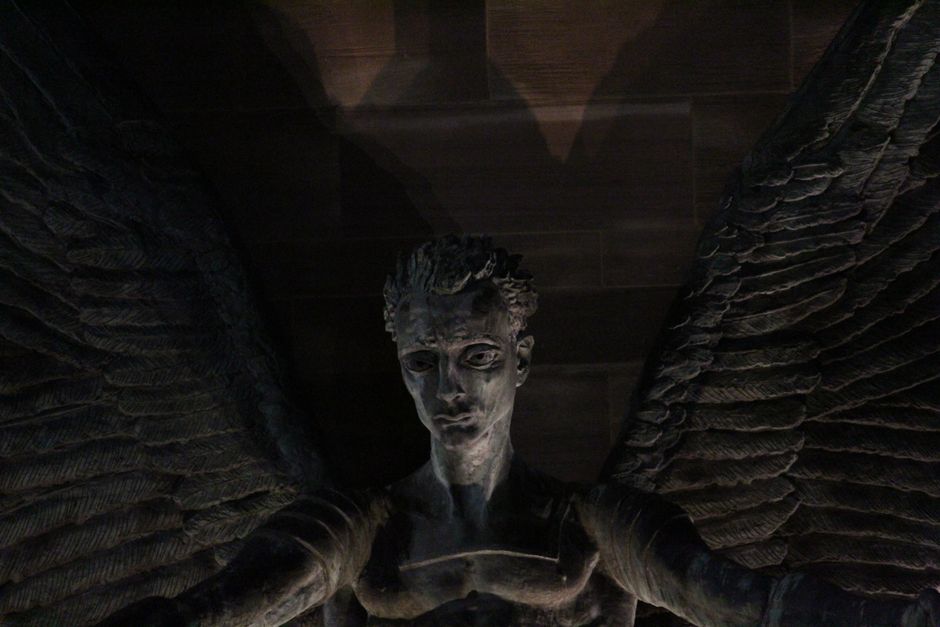
Somewhere between scripture and nightmare, the legend of Satan has taken root. He is the shadow that waits behind the altar, the voice that speaks in moments of weakness, the figure glimpsed in old paintings and older dreams. For centuries, believers, scholars and storytellers have shaped his image from the same dark materials: rebellion, pride, temptation and the terrible weight of a fall from grace. His story refuses to sit still. It shifts across traditions, changes names and never settles into a single version. What follows traces the Adversary from his earliest role as a servant of heaven to his enduring place as the great enemy of the human soul.
The Origins of the Legend
According to the traditions that shaped his story, Satan was not always the enemy. God created him as the head of the angels, making him the most powerful, intelligent and beautiful being in the heavenly host. He is described as one of the cherubim, powerful angelic figures who stand close to the presence of God. In this early form he was known as Lucifer, and some accounts remember him as the Minister of Music in Heaven, the angel who once stood at the heart of heaven’s praise. The horror of his later story comes from this beginning. The greatest light in heaven did not fall from weakness but from strength.
The precise details of his origin vary between sources, and the legend has never been told exactly the same way twice. What remains consistent is the sense of a being set above all others, gifted beyond measure, and yet destined to ruin. That contrast between glory and damnation is what gives the legend its power. A monster born in darkness is frightening, but a fallen angel is something worse, because his darkness was once light.
The Rebellion and the Fall
The turning point in the legend is rebellion. Satan is traditionally understood as an angel who turned against God and was cast out of heaven along with the other fallen angels who followed him. This expulsion is said to have taken place before the creation of humankind, setting the fall at the very beginning of the world’s story. Pride is the sin most often attached to his name. The being who had stood at the centre of heaven’s light chose defiance, and the price of defiance was the loss of his place among the cherubim.
What remained was the shadow of what he had been: a creature of immense power, now devoted to opposition. The story carries an unsettling implication for anyone who reads it closely. If the most beautiful and intelligent of all angels could fall, then no amount of light is safe. The legend proposes that evil began not in the mud of the earth but in the highest place imaginable, and that thought has haunted the human imagination ever since.
The Adversary in Jewish Tradition
The Jewish understanding of this figure is more subtle than the later Christian image. In Judaism, Satan is one of the many spiritual messengers that God sends to accomplish his purpose. He is an agent subservient to God, with no power independent of the divine will. The name Ha-Satan, meaning the Adversary, describes a role rather than an enemy. In this reading, the Adversary acts as an accuser and a tester, a figure who challenges and probes the faithful under heavenly authority.
This version of the figure is not a rival god and not a being of pure evil. He is part of the machinery of heaven, however unsettling the thought may be. The difference between this portrait and the later Christian one is striking. The servant who tests becomes, in time, the enemy who tempts. The legend did not change all at once. It twisted slowly, generation by generation, until the accuser became the accused and the servant became the serpent.
The Many Names of the Tempter
Across the centuries, the legend of Satan has accumulated names the way a shadow accumulates shape. Each title reveals a different face of the same presence. The Tempter speaks to human desire, the Evil One embodies corruption, the Adversary stands against the faithful, and the Devil has become the common title by which he is known in Christian tradition. One older tradition remembers him as Samael, a name that carries its own dark music.
Title | Role in the Legend |
|---|---|
Ha-Satan | The Adversary, the accuser who tests the faithful |
The Tempter | The one who entices humans into sin and falsehood |
The Evil One | The embodiment of wickedness in opposition to God |
The Devil | The most common Christian title for the same figure |
Samael | An older name attached to the legend in certain traditions |
Together these names build a portrait of a being who is always present at the edges of human choice, always ready to twist longing into sin and faith into falsehood. The multiplication of names is part of the horror. A creature with one name can be understood, watched, resisted. A creature with many names slips through the mind like smoke, impossible to hold in a single grasp.
The Serpent in the Garden
No version of the legend is darker than the story of the serpent in the Garden of Eden. In popular belief, the serpent of Genesis and Satan are the same figure, and the identification has become one of the most powerful images in religious history. The tempter who seduced humanity into eating the forbidden fruit is understood to be the same angel who fell from heaven, continuing his rebellion through the ruin of the first man and woman. The Garden becomes the first battlefield, and humanity’s exile is the first wound.
What makes this version of the legend so disturbing is its intimacy. The Adversary does not appear as a monster in the story of Eden. He comes as a voice, a whisper, a suggestion. He does not force the choice; he simply offers it. That detail has echoed through every retelling since. The devil of the Garden is not a beast at the gate but a conversation in the dark, and that is far closer to the way temptation actually works.
The Shadow Over the World
In Christian theology, the role of Satan grows far beyond the Garden. He is described as the ultimate source behind every false cult and world religion, the hidden power that opposes God in all things. This is the enemy who will do anything and everything in his power to drag souls away from the light. He is no longer a servant of heaven but a predator loose in the world, and the battle against him is spiritual, constant and deeply personal.
For many believers, this is the true heart of the legend: not a distant myth but a present danger. The shadow is always close. He appears in the moment of weakness, the flash of anger, the secret desire that should not be spoken. The legend insists that evil is not an abstract idea. It has a face, a will and a patient intelligence, and it is watching.

The Legend Endures
Whatever a person believes, this legend has left an indelible mark on the human imagination. He appears in art, literature, music and the quiet fears that surface in the dark. He is the whisper in the empty room, the shape at the edge of vision, the reason we check the shadowed corner before we sleep. Horror writers have drawn from his story for centuries because it speaks to something primal: the fear of a conscious evil, older than humanity, patient beyond measure and endlessly inventive in its cruelty.
The story may have begun in heaven, but it now belongs to the dark places of the world. It lives in the burnt church and the locked cellar, in the forest at night and the mirror when the light is low. The legend of the fallen angel will not fade, because it answers a question that refuses to die. If there is light, why is the world so dark? The legend offers one terrible answer: because something from the light chose the dark, and it wants company.
Frequently Asked Questions
These are the questions that most often follow any conversation about the legend.
What does the name Satan mean?
The name Satan is closely tied to the Hebrew title Ha-Satan, which is often translated as the Adversary. It describes a role as much as a being: one who opposes, accuses or tests. In Jewish tradition, this role is carried out under God’s own authority, while in later Christian thought the name became the personal title of the chief enemy of God.
Is Satan the same as Lucifer?
In popular belief, the two names describe the same figure. Satan, or Lucifer, is understood as a fallen angel who was created as the head of the angels, known for his intelligence and beauty, and cast out of heaven after rebelling against God. Some traditions also identify him with the serpent in the Garden of Eden.
What is the difference between the devil and Satan?
The two names are generally used interchangeably. The Devil is one of the titles given to Satan, along with the Tempter, the Evil One, the Adversary and Samael. Each title emphasises a different aspect of his role, but all of them point to the same figure of evil in the Abrahamic traditions.
Did God create Satan?
According to the traditions captured in scripture, God created Satan as the head of the angels, making him the most powerful, intelligent and beautiful of the heavenly host. His rebellion and fall came later. This means the figure of evil, in these accounts, began as a being of great light and dignity.