


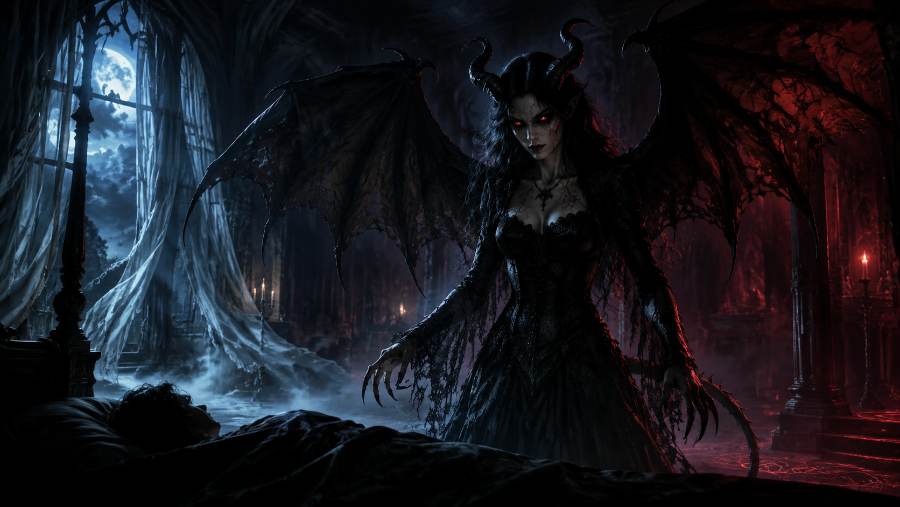
She enters without opening a door. The sleeper wakes beneath the crushing weight of an unseen presence, unable to move, breathe or call for help. A beautiful woman emerges from the darkness, but the face she wears conceals something ancient and predatory. According to centuries of supernatural folklore, the succubus is an evil female demon that visits people in their sleep, exploiting desire before draining its victim’s strength, sanity and life.
Unlike monsters that attack with visible claws and teeth, this creature turns intimacy into a weapon. It does not need to break into a house because it enters through dreams. It studies loneliness, grief and hidden desire, then assumes the form its chosen victim will find impossible to resist. Many accounts of succubus describe the same unsettling pattern: sleep, pressure, fear, and the feeling of a presence close by.
Ancient Origins of a Night Demon
The word succubus comes from the Late Latin term succuba, meaning a lover who lies beneath another person. Although the familiar name emerged during the medieval period, stories of female spirits visiting sleepers existed in far older cultures.
Ancient Mesopotamian traditions described dangerous night spirits associated with seduction, illness and infant death. Later Jewish folklore told of Lilith and other female demons that preyed upon people during darkness. These figures were not identical, but they helped shape the image of a supernatural woman who entered bedrooms without permission and attacked while her victim remained vulnerable. In older demonology, succubus was not just a frightening story but a way to explain experiences people found disturbing and difficult to discuss.
Medieval theologians developed the legend further. They argued over whether such demons possessed physical bodies or merely created convincing illusions. Some believed the creatures collected human seed for use by male demons known as incubi. Others treated nocturnal encounters as evidence of temptation, witchcraft or spiritual corruption.
These explanations reflected the religious fears of the period. Desire outside accepted boundaries became dangerous, while vivid dreams and unexplained physical sensations could be interpreted as demonic assault. The night visitor offered a terrifying explanation for experiences people could not understand.
How the Demon Attacks
The traditional encounter begins during sleep. A person senses someone entering the room but cannot lift their head or move their limbs. Pressure settles across the chest. Breathing becomes difficult. A figure appears near the bed, sometimes beautiful and sometimes hideously deformed.
The victim may experience the attack as a dream, yet wake with the conviction that it physically occurred. Scratches, bruises, exhaustion and missing memories are frequently woven into later accounts. Repeated visits leave the target increasingly weak and afraid to sleep.
A succubus does not always attack immediately. In many legends, it cultivates dependence. The first dreams may feel comforting or intensely pleasurable. The spirit offers companionship, fulfils secret fantasies and creates a private world more appealing than waking life.
Only after the bond has formed does the true cost emerge. The victim withdraws from friends, loses interest in ordinary relationships and begins waiting for the next visit. Sleep brings the demon closer, while remaining awake causes exhaustion and confusion. Either choice weakens the target.
The creature feeds upon more than physical vitality. It consumes attention, hope and emotional independence until the victim no longer recognises the life being destroyed around them. For related reading, see Succubus: The Evil Demon That Hunts Through Dreams.
Beauty Concealing Something Monstrous
Artists and storytellers often portray the succubus as an extraordinarily beautiful woman with subtle demonic features. Horns rise through dark hair, leathery wings fold behind her shoulders, and a pointed tail betrays the body she attempts to disguise. Her eyes may glow red or become completely black when the illusion fails.
Other depictions make her transformation more disturbing. Smooth skin cracks to reveal scales. Elegant fingers lengthen into claws. A seductive smile stretches too far across the face, exposing teeth designed for tearing rather than kissing.
Her beauty is not genuine. It is bait.
The creature can allegedly change its appearance according to the desires of whoever sees it. One victim may encounter a mysterious stranger, while another sees a lost lover or someone they have secretly wanted. By reflecting desire back at the target, the demon ensures that temptation feels personal.
This ability also prevents witnesses from agreeing upon one appearance. Every account describes a different face because the monster does not possess a fixed human identity. Its true form may exist only beneath the glamour, hidden until resistance becomes impossible. For broader authority context, visit Library of Congress.
The Connection to Sleep Paralysis
Modern science provides a convincing explanation for many historical night-demon encounters. Sleep paralysis occurs when a person becomes mentally aware while the body remains in the temporary muscular paralysis associated with rapid eye movement sleep.
During an episode, the individual may be unable to move or speak. Pressure on the chest, difficulty breathing and vivid hallucinations can accompany the experience. People frequently sense a hostile presence nearby or see a figure standing beside the bed.
Culture influences how that figure is interpreted. Someone familiar with demon legends may see a supernatural seducer, while another person imagines a shadow, ghost, witch or intruder. The experience feels real because dream imagery overlaps with awareness of the actual bedroom.
Scientific explanation has not destroyed the legend. Sleep paralysis explains the physical sensations, but sufferers often insist that the intelligence behind the encounter felt independent and deliberate. For believers, medicine describes the doorway without identifying what might pass through it.
A Symbol of Dangerous Desire
Beyond literal belief, the legend represents anxiety about desire becoming destructive. The demon offers pleasure without trust, intimacy without human connection and fulfilment without consequence—until the hidden price becomes clear. For related reading, see Succubus: The Evil Demon That Hunts Through Dreams books.
The story can also express fear of obsession. A victim willingly returns to the same dream despite recognising the danger. Friends issue warnings, health deteriorates and ordinary life collapses, yet the supernatural relationship grows stronger.
This makes the creature effective in psychological horror. It does not merely overpower its target. It persuades the victim to participate, blurring the boundary between possession and surrender. The most frightening question is not whether someone can escape, but whether they still want to.
The Demon in Modern Horror
The succubus continues to appear in horror novels, films, television, games and paranormal accounts. Modern storytellers have expanded the legend beyond its medieval framework, portraying the demon as a dream predator, shapeshifter, immortal temptress or parasite feeding upon emotion.
Some stories give the creature tragic motives, while others preserve its absolute evil. It may stalk grieving people, infiltrate relationships or offer to restore someone the victim has lost. The most effective versions understand that temptation must promise something meaningful.
A person rarely destroys their life for beauty alone. They may do it for love, forgiveness, youth or one final conversation with the dead. The demon discovers that need and builds the trap around it.
This adaptability keeps the legend alive. Social attitudes change, but loneliness, forbidden desire and fear of losing control remain deeply human. The creature survives because it can wear whatever face a new generation finds most difficult to reject.
Do Not Answer the Voice in Your Dreams
The succubus remains one of folklore’s most intimate and disturbing demons. It attacks in the bedroom, invades dreams and transforms private desire into a path toward ruin. Whether understood as a medieval warning, a supernatural predator or an interpretation of sleep paralysis, its legend continues to thrive wherever darkness and vulnerability meet.
If a beautiful stranger calls your name from inside a dream, wake before she reaches the bed.
If you cannot move, do not look into her eyes. For broader authority context, visit Encyclopaedia Britannica overview of ghosts.
She has already learned what you want, and she intends to make certain you never wake wanting anything else.