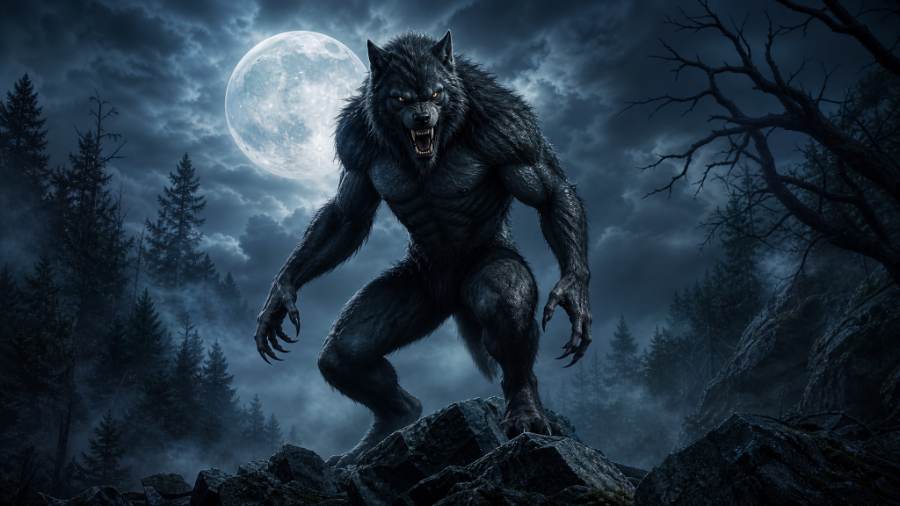
For centuries, stories have warned of human beings capable of transforming into savage, wolf-like creatures. The werewolf has become one of the most recognisable monsters in supernatural folklore, appearing in ancient legends, medieval accounts, Gothic fiction and countless horror films.
Modern audiences know the familiar story: an ordinary person is bitten or cursed, the full moon rises, and an uncontrollable transformation begins. Bones twist, teeth become fangs, and the human disappears beneath the instincts of a predator.
Yet this familiar image is largely the product of centuries of evolving folklore. The original legends were far more varied and, in some cases, considerably darker.
Behind them lies an ancient human fear—the possibility that civilisation is only a thin barrier concealing the beast within.
Ancient Origins of the Werewolf Legend
Stories about humans becoming wolves existed long before medieval Europe.
One of the best-known examples appears in ancient Greek mythology. King Lycaon of Arcadia supposedly attempted to test Zeus by serving him human flesh. Enraged by the act, Zeus transformed Lycaon into a wolf.
The story is particularly significant because the word lycanthropy, meaning transformation into a wolf, derives from the Greek name Lycaon.
Other ancient cultures also possessed traditions involving shapeshifters, animal spirits and warriors who adopted the characteristics of dangerous predators.
The wolf was particularly powerful as a supernatural symbol.
Wolves were intelligent hunters capable of travelling great distances and surviving in hostile environments. For communities whose livestock and personal safety could be threatened by wolf packs, they represented a very real danger beyond the boundaries of settlement.
Werewolf Beliefs in Medieval Europe
During the medieval and early modern periods, European stories about human transformation became increasingly connected with witchcraft, curses and the Devil.
People accused of becoming wolves might supposedly achieve the transformation by wearing an enchanted belt or animal skin, applying a magical ointment or entering into a supernatural agreement.
In some traditions, the condition was involuntary. A person could become cursed through circumstances beyond their control.
In others, transformation was portrayed as deliberate.
This distinction dramatically changed the meaning of the legend. A cursed individual could be viewed as a tragic victim, while a voluntary shapeshifter might be regarded as a servant of evil.
Belief in such creatures became particularly frightening when accusations moved from folklore into actual criminal proceedings.
The Dark History of Werewolf Trials
Europe witnessed a number of notorious trials involving people accused of transforming into wolves.
One famous case involved Peter Stumpp, a German farmer executed in 1589 after being accused of murder, cannibalism and supernatural transformation. Accounts claimed that he possessed a magical belt given to him by the Devil that allowed him to assume the form of a wolf.
The sensational details surrounding the case circulated widely.
Another notorious figure was Gilles Garnier, executed in France during the sixteenth century after being accused of killing children and committing acts associated with lycanthropy.
Such cases need to be understood within the religious fears, judicial practices and social conditions of their time. Confessions could be extracted through torture, while unexplained murders and animal attacks created powerful pressure to identify a culprit.
Nevertheless, the surviving records demonstrate that supernatural transformation was sometimes treated as a terrifying reality rather than harmless folklore. For related reading, see Werewolf: The Terrifying Legend of the Beast Within.
The Curse and the Bite
Modern horror fiction frequently portrays lycanthropy as something transmitted through a bite.
A victim survives an attack only to discover that they have inherited the monster’s curse. When the transformation arrives, they become dangerous to the people they love.
This concept is enormously effective for storytelling because it transforms the monster into a tragic figure.
The victim may remain completely human for most of the time. They understand what is happening and desperately attempt to prevent the next transformation, but eventually lose control.
Older folklore contains many different explanations for becoming a wolf, and the now-familiar infectious bite was not a universal rule.
Cinema helped standardise it.
The Werewolf and the Full Moon
Few images are more closely associated with the werewolf than a full moon shining through dark clouds.
Yet the connection is not as straightforward historically as modern popular culture suggests.
Traditional European folklore contained numerous ideas about when and how transformation occurred, and the full moon was not always essential.
Twentieth-century cinema played an enormous role in establishing the lunar transformation as one of the fundamental rules of the modern myth.
The image proved irresistible. For broader authority context, visit Library of Congress.
The moon creates a perfect supernatural clock. A cursed person knows exactly what is approaching but is powerless to prevent it. As daylight disappears and the moon rises, human reason gives way to animal instinct.
That inevitability creates much of the horror.
Can Silver Kill a Werewolf?
Another familiar rule states that the creature can only be killed with silver.
Silver has long possessed symbolic associations with purity and supernatural protection, but the idea of the silver bullet as the universal weapon against wolf-like monsters became especially prominent through later storytelling and popular culture.
One frequently cited legend involves the Beast of Gévaudan, a mysterious animal or animals blamed for numerous deadly attacks in eighteenth-century France.
Later retellings sometimes claimed that the beast was killed with a silver bullet. However, separating historical evidence from embellishment is difficult.
Modern horror eventually made the rule simple: ordinary weapons may fail, but silver can destroy the monster.
Wolves, Fear and Misidentification
Real wolves probably contributed to the development of transformation folklore.
Before their disappearance from many parts of Europe, wolves represented genuine threats to livestock and occasionally humans. An unexplained attack could therefore create rumours that something unnatural was roaming beyond the village.
Certain medical and psychological conditions may also have influenced historical interpretations. For related reading, see Werewolf: The Terrifying Legend of the Beast Within books.
The term clinical lycanthropy is now used for a rare psychiatric phenomenon in which a person believes they are transforming into, or have become, an animal.
This does not explain the mythology as a whole, but it demonstrates how unusual behaviour could have been interpreted very differently in societies where supernatural transformation was considered possible.
The Beast Within
The most powerful element of the werewolf legend may have little to do with wolves.
Unlike many supernatural monsters, the creature begins as an ordinary human being.
The monster therefore represents loss of control.
Anger, violence and animal instinct overwhelm civilisation, morality and reason. The person may awaken afterwards horrified by actions they could not prevent.
This dual identity has made lycanthropy a remarkably flexible metaphor for rage, addiction, puberty, sexuality and suppressed violence.
The monster is frightening because it does not necessarily wait outside the door.
It may already be inside us.
From Folklore to Horror Cinema
Literature and cinema transformed the legend into a modern horror icon.
Films such as The Wolf Man helped establish many conventions now considered inseparable from the mythology, including tragic transformation and the vulnerability to silver.
Later films made the physical transformation increasingly dramatic. Advances in special effects allowed audiences to watch the human body apparently change before their eyes.
Modern novels, television series and paranormal fiction have expanded the mythology even further, sometimes portraying wolf-like shapeshifters as heroes rather than monsters.
The legend continues to evolve.
Why the Werewolf Legend Survives
The enduring fascination with the werewolf comes from its combination of ancient fear and deeply human psychology.
Wolves once represented genuine danger in the darkness beyond civilisation. Transformation stories turned that external threat into something far more disturbing—a human being capable of becoming the predator.
Whether interpreted as supernatural folklore, historical superstition or a symbol of humanity’s hidden instincts, the legend continues to haunt popular culture.
Vampires fear death. Ghosts return from it.
But the wolf-like monster represents something different: the terrifying possibility of losing control of ourselves.
When the moon rises in the old stories, the question is not simply whether a monster is waiting in the darkness. For broader authority context, visit Encyclopaedia Britannica overview of ghosts.
It is whether the monster was human all along.